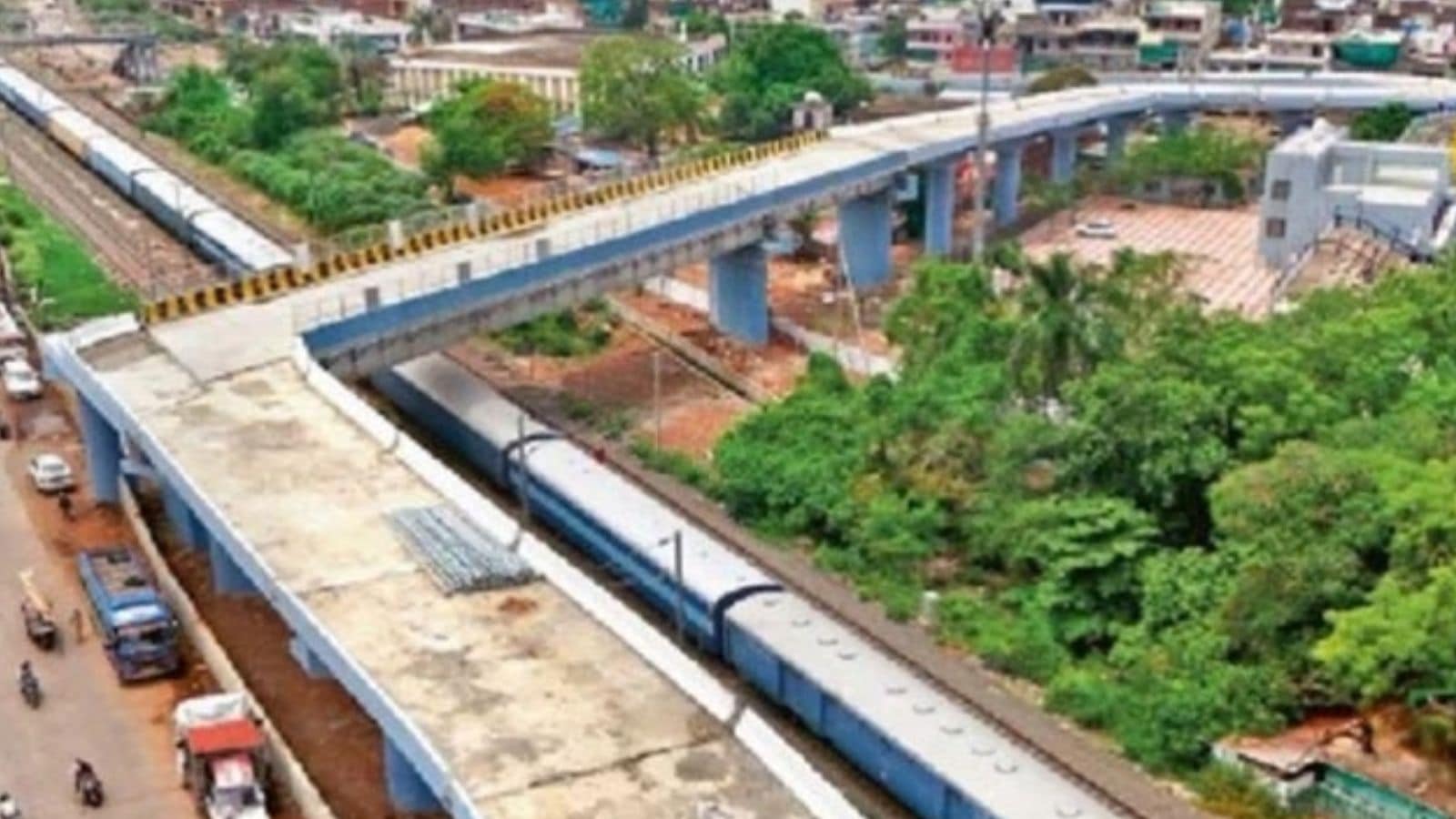
A newly constructed rail overbridge (Rob) in Bhopal, who made headlines for a twist of about 90 degrees, has quickly gone from the subject of a matter of an investigation. And, as -In an investigation, it is known that due to peculiar construction, Madhya Pradesh Public Works Department (PWD) officials and Indian Railways appear defective faults.
The 648-meter bridge in the Aishbagh region, which cost Rs 18 crore to construct, was meant to eliminate the long delay at the railway crossing and shorten the commute for about three lakh people daily.

PWD engineer-in-chief KPS Rana told The Indian Express The design of the bridge was approved in 2018 and was originally executed by a team from the Bridge Engineering Department, which included Assistant Engineer, Superintendent Engineer, Executive Engineer and Chief Engineer Level Officer.
“We have formed a committee to watch the role of these officers,” he said. Rana insisted that a comprehensive layout scheme required for all ROB projects, general arrangements drawing (GAD), was prepared in collaboration with Indian Railways and supervised within PWD by Chief Engineer (Bridge). Chief Engineer (Bridge) GP Verma refused to comment on the case.
Rana said that “final approval” remained within the Chief Engineer (Bridge) Department, and “the design did not proceed to higher officials.”
“It was the Bridge Engineering Department, which was dealt with design. The GAD was prepared with the help of railway officials and PWD officials. A private contractor was engaged to execute the work, and he also has a final role to execute the design in later stages. If he had done better, we could be ready to create our own.
Rana said that the project faced spatial obstacles, and the issue of alignment should have been marked in the first GAD formulation phase.
The story continues below this advertisement
He said, “There was a lack of communication between various departments on this. If we could get it at the reception stage, the railway project could refuse to approve. Then we could work on a readingine,” he said.
And so, the department proceeded with the current design, and options such as an underground crossing or various alignment were not discovered, Rana said.
Railway spokesman Naval Aggarwal admitted that both departments had coordinated during the design phase and the Railways had expressed initial concern about the alignment. “We had done our work and built our share of Rob according to Gaid. We had communicated the PWD at the design flaws through a letter some time ago. We did our job.”
Chief Project Manager, Anupam Awasthi refused to comment in detail, just saying that he was not involved when the gad was prepared and suggesting that the flaws of any design could be addressed through an amendment proposal at that time. “If an approach was the problem, an amendment motion could have been done. It was not done,” he said.
The story continues below this advertisement
The construction contract was given to M/S Punit Chadha, a private firm located in Bhopal. Senior Structure Engineer Kailash Kushwaha, who worked on the site for two years, looked after a team of 60 people, saying that the design came directly from PWD. He said that the bridge was forced by limiting the available space by metro construction by an electrified railway line on one side and on the other side.
He said that he worked with the Chief Engineer (Bridge). “PWD raised these issues of space lack; it is mainly the fault of the Railway Department that they did not coordinate with us,” Kushwaha alleged.
PWD has formed a four -member committee including two chief engineers and an executive engineer on the orders of PWD Minister Rakesh Singh. This committee will assess the design, evaluate accountability and recommend corrective measures. Safety measures under consideration include installation of speed breakers at five locations, mirrors for visibility at 90-degree turn, reflective radium strips, speed limit limit signing, 20 new streetlights on the bridge, and widening the curve using the garbers on the triangle base of Rob.
,