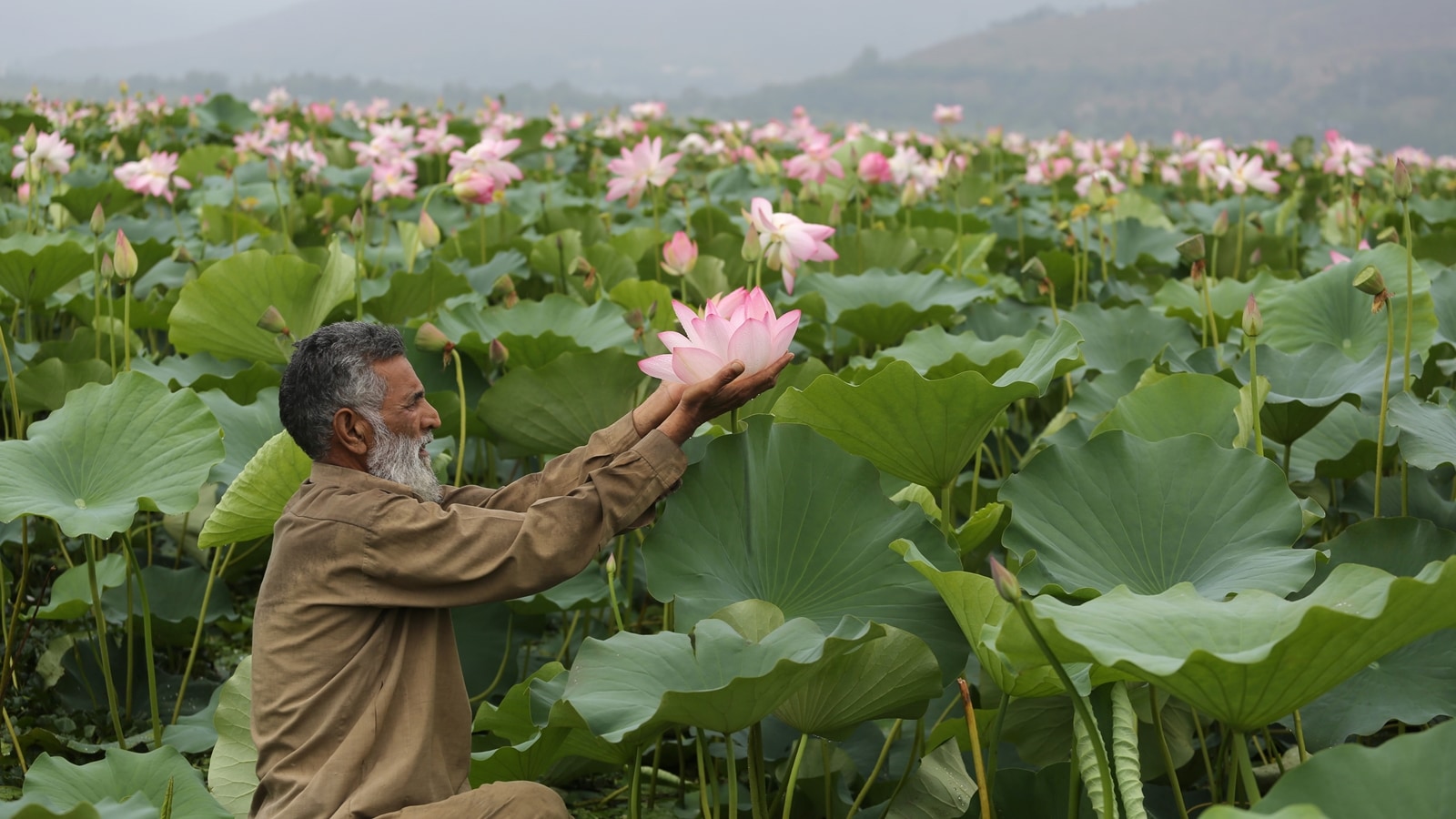
Abdul Rashid Dar sits on the banks of the Wular lake in Bandipora in Kashmir, which stares in surprise. The front is a sea of pink lotus, all bloom completely. “I can’t believe my eyes” he says he touches one delicately. “When I was a child, I used to be with my father to harvest the stems of Lotus, but it was long ago. I felt that we had lost this gift of God forever.”
Some are happening in remarkable wolar – Asia’s largest freshwater lake which is located in Bandipora. Surrounded by a delightful lake and Misty Hormukh mountain, located about 67 km from Srinagar, once again became a lotus house after 30 years, when a disastrous flood completely dropped them out of the area.

The change has been thanked by the Wular Protection and Management Authority for the conservation efforts. The authority started provoking the lake in an attempt to clean the silt from the flood.
“Lotus has seen a revival in areas where we have removed silt in the last few years. Since the seeds of Lotus were deeply buried inside the silt and soil, they could not grow. Now the silt has been removed, Lotus has developed again,” a zonal officer of the Wular Protection and Management Authority is called Mudseer Ahmed.
For the population struggling with declining income and rising unemployment, there are economic implications of development – this means revival of lotus stem harvesting, a traditional business here.

“This is almost a miracle,” 43 -year -old Dar, whose father was a lotus stem farmer, says.
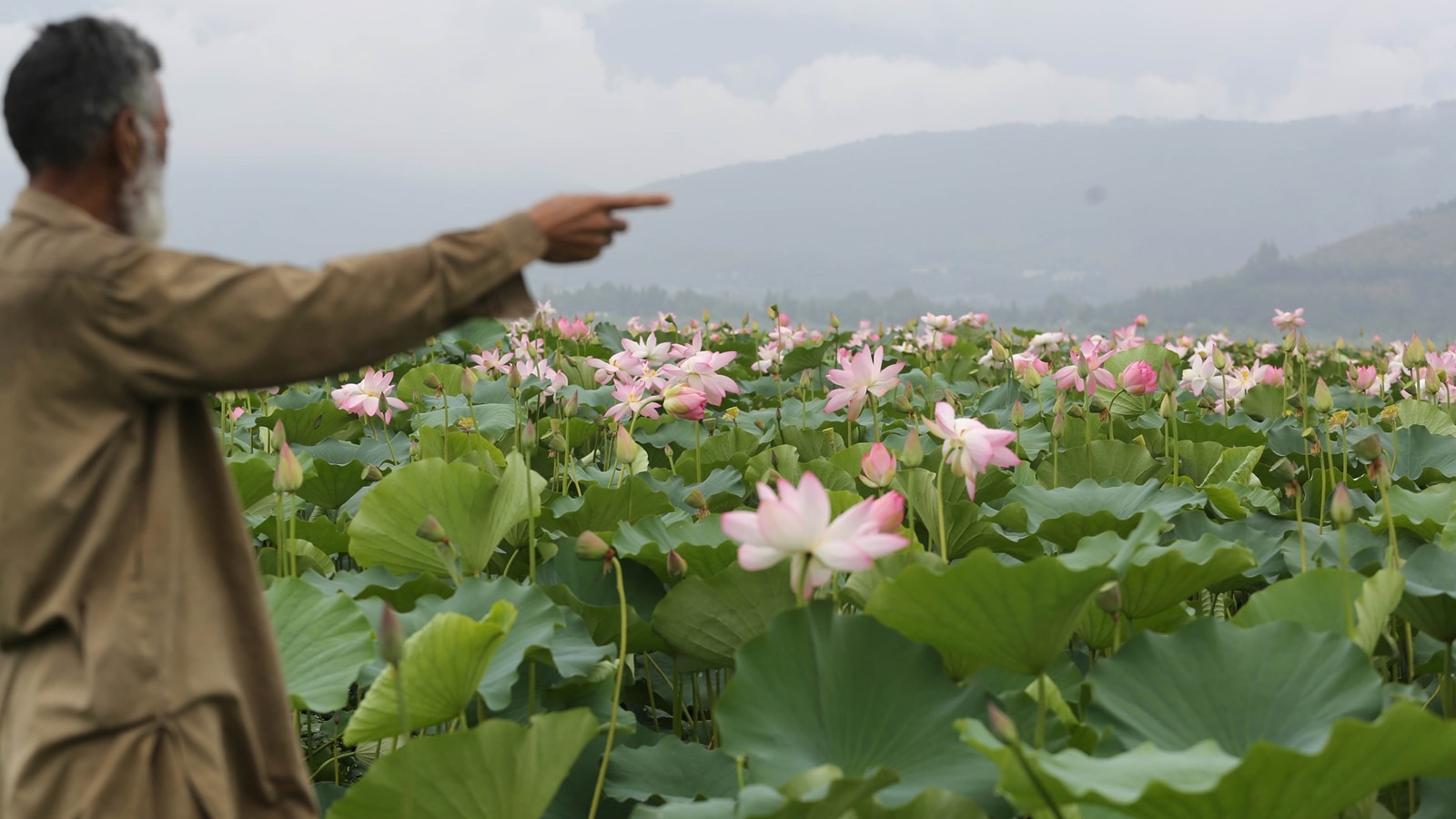 Abdul Aziz Dar, a lotus stem farmer and a local resident, touches a lotus in the Wular Lake in Bandipora, Kashmir. (Photo Express by Shuib Masudi)
Unexpected change
The story continues below this advertisement
Located between Bandipora and Sopore towns and spread to about 200 sq km, the lake was once filled with lotus. Locally known as Nadru is a delicateness in Kashmir, where it is cooked with fish or curd, known as Nadru Yakhani.
The lotus also grows in the dal and Manasbal lake of the valley, where its stem harvesting is a means of livelihood. Generally, the process of labor-intensive process, harvesting involves diving of deep necks in water to regain the stem to farmers.
Image of September 1992.
For residents, it meant loss of livelihood. Ghulam Hasan Reshi, a resident of Lankarsipora village on the banks of the lake, said, “That year, Lotus had completely blossomed.” “Then we lost Kamal forever. At least we thought in this way, so far.”
The story continues below this advertisement
However, an official said that while the stems of Lotus could not grow for harvesting since 1992, records show that its rhizome – or its creeping root stalks – were still present in the lake until 25 years ago.
The turnaround came unexpected. In 2020, the Wular Conservation and Management Authority (WUCMA) launched an ambitious project to retrieve the lake and its rich ecosystem.
A part of the project was to lift the silt from the lake.
Efforts were paid – Last year, Lotus showed the first signs of revival. Encouraged, the authority scattered lotus seeds in the lake this year, calling Mudsir Ahmed, zonal officer of the Wular Protection and Management Authority.
The story continues below this advertisement
Local resident Ghulam Hasan Reshi says, “Dreging changed all this.” “For many years, the villagers spread lotus seeds in the lake, but did not work,” they say.
Meanwhile, efforts to revive the Wular continued. The lake, whose fish is known for its distinct taste, has become a receptac for all silt and garbage thrown in the Jhelum River over the years and 25 other streams that feed it.
“We have so far removed 79 lakh cubic meters of silt from the lake,” Ovis Farooq Mir, a former officer of the Wular Protection and Management Authority who was recently with the authority. “We are in the process of manufacturing retention basins on the major stream to prevent waste and silt from entering the lake”.
This all means additional income for the local community. In the lake, 60 -year -old Abdul Aziz Dar, some young boys click photos near the shore of the lake.
The story continues below this advertisement
“When some flowers used to bloom last year, we did not let anyone harvest them. We did not want to lose them again,” he said. “The good thing is that it is cut in a season when there are very few options for work – from September to March.”
,